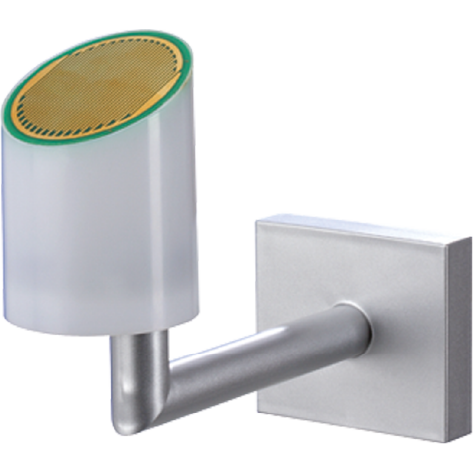
Core (KNX) components
With the (KNX) building technology, virtually the complete building technology can be implemented and controlled. This technology can provide much more than convenience for the guest. With the smart KNX ceiling observers, you can detect unfavourable conditions such as leakage, temperature change or strong wind in good time and minimise the follow-on damage.
You can find a complete overview of all components and application possibilities in the JUNG KNX catalogue (https://www.jung-group.com/de-DE/Katalog/KNX/).
In addition, you can find further information on DALI and the DALI devices listed here: www.jung-group.com/en-DE/Products/Solutions/DALI/
Multi stations
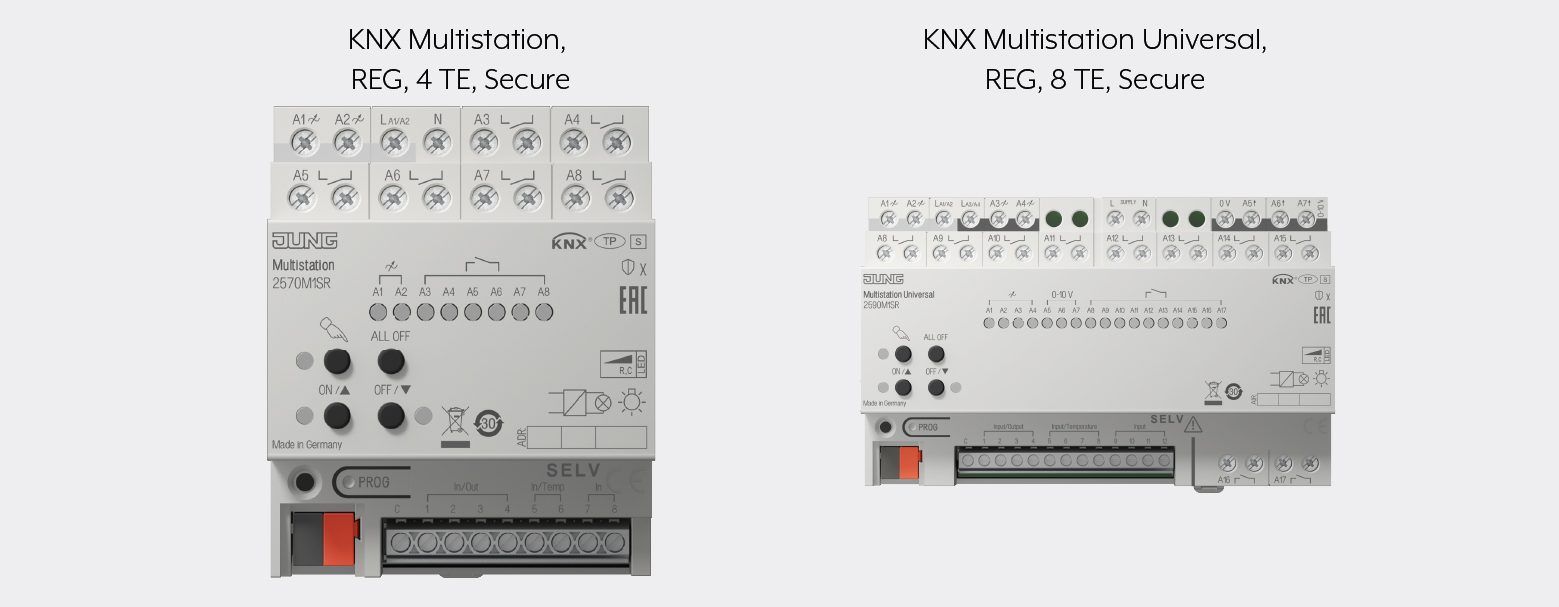
Other products
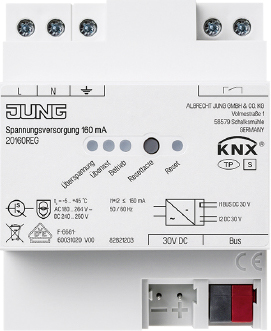
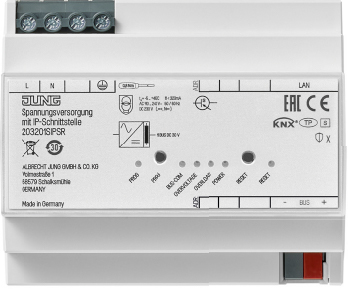
Every room has its own power supply. Here is the device with 160 mA.
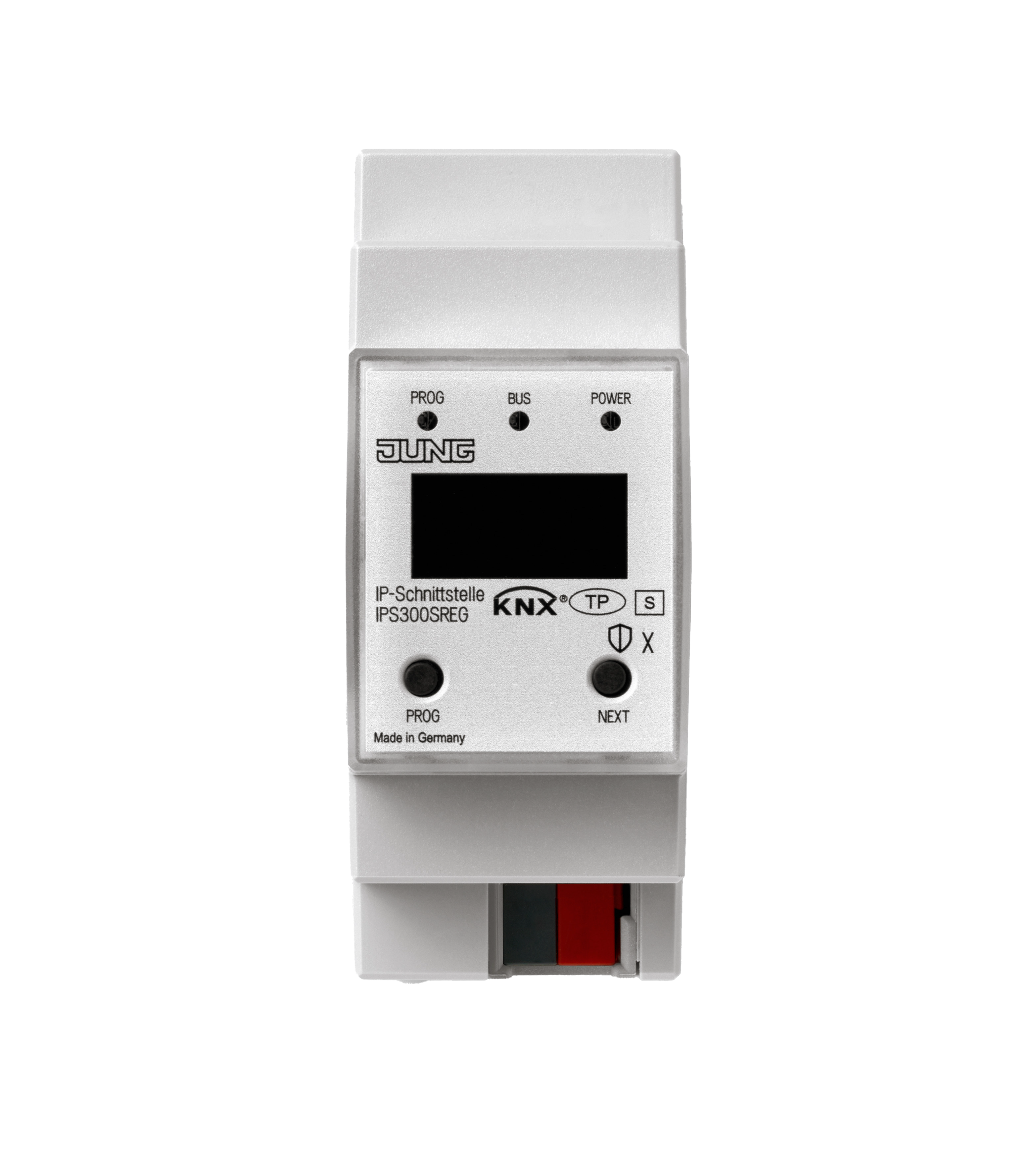
With the IP gateway, information can be processed centrally at reception.
The combination device combines power supply and IP interface.
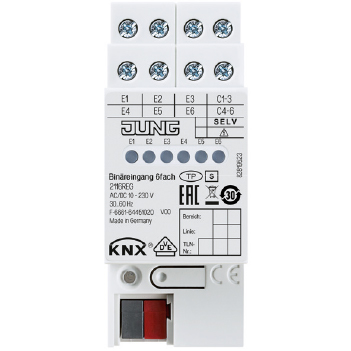
The binary interface integrates the DND/ MUR system and the key card holder.
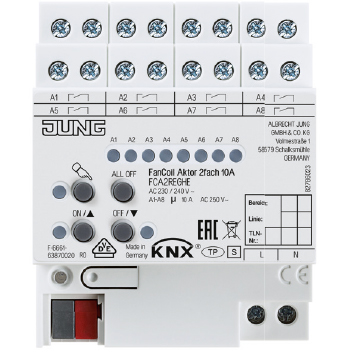
Temperature regulation with fan coil unit regulator and valve drive.
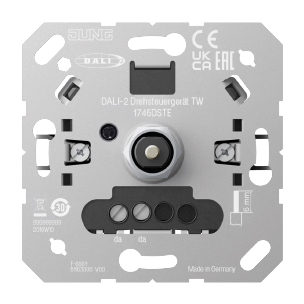
The DALI-2 rotary controller TW is used for brightness setting for luminaires with a DALI interface. The rotary controller is a rotary controller for higher-level DALI-2 controls and additionally multi-master capable. The rotary controller can be installed in a commercially available wall box according to DIN 49073.
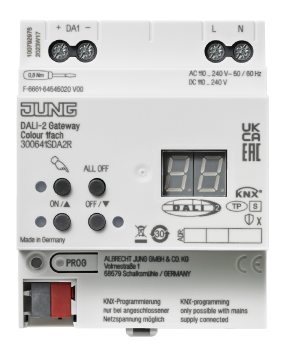
The JUNG KNX DALI-2 Gateway Colour 1-gang, for rail mounting, 4 rail units, Secure enables the control of luminaires and other applications with a DALI operating unit in installations, such as electronic ballast. With the Gateway Colour 1-gang, a max. of 64 DALI devices can be controlled in a max. of 32 groups. The JUNG KNX DALI-2 Gateway Colour 1-gang is thus particularly suited for use in hotels, museums or exhibition spaces. Mounting is on a DIN rail according to DIN EN 60715 in a distribution box.
DALI-2 sensors (e.g. push-button sensors, rotary sensors, presence detectors or brightness sensors) are supported as input devices in Instance mode (from firmware version 2.0.x and application program version 2.2).
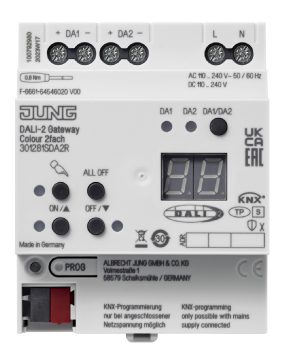
The JUNG KNX DALI-2 Gateway Colour 2-gang, for rail mounting, 4 rail units, Secure enables the control of luminaires and other applications with a DALI operating unit in installations, such as electronic ballast. With the Gateway Colour 2-gang. a max. of 2 × 64 DALI devices can be controlled in a max. of 2 × 32 groups. The JUNG KNX DALI-2 Gateway Colour 2-gang is thus particularly suited for use in hotels, museums or exhibition spaces. Mounting is on a DIN rail according to DIN EN 60715 in a distribution box.
DALI-2 sensors (e.g. push-button sensors, rotary sensors, presence detectors or brightness sensors) are supported as input devices in Instance mode (from firmware version 2.0.x and application program version 2.2).
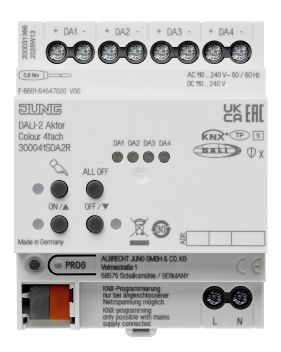
The JUNG KNX DALI-2 actuator Colour 4-gang, for rail mounting, 4 rail unit, Secure enables the control of lights and other applications with a DALI operating unit in installation, such as electronic ballast. With the actuator Colour 4-gang, a max. of 128 DALI devices in 4 DALI systems can be controlled. The JUNG KNX DALI-2 actuator Colour 4-gang is thus particularly suitable for use in hotels, museums or exhibition spaces. Mounting is on a DIN rail according to DIN EN 60715 in a distribution box.
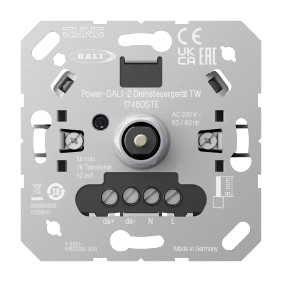
The Power-DALI-2 rotary controller TW is used for brightness setting for luminaires with a DALI interface. The rotary controller is a rotary controller for higher-level DALI-2 controls and additionally multi-master capable. In addition, the rotary controller has an integrated bus power supply for up to 26 DALI devices. The rotary controller can be installed in a commercially available wall box according to DIN 49073.
The DALI rotary controller TW is used for brightness setting for luminaires with a DALI interface. With the rotary controller, the colour temperature for luminaires with DALI Device Type 8 for Tunable White can be set. In addition, colour temperature limit values and the basic brightness along with switch-on brightness can be stored. The rotary controller can be installed in a commercially available wall box according to DIN 49073.
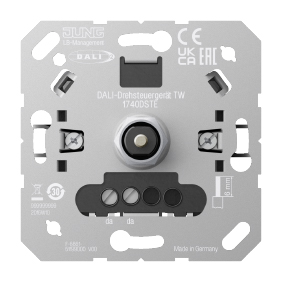
The power DALI rotary controller TW is used for brightness setting for luminaires with a DALI interface. The rotary controller provides the control current for up to 28 DALI devices and can store colour temperature limit values as well as basic brightness and switch-on brightness. The rotary controller can be installed in a commercially available wall box according to DIN 49073.
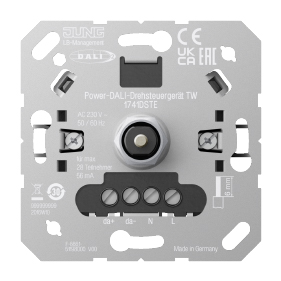
The power DALI push-button controller TW is used for switching and for brightness setting of luminaires with a DALI interface. The push-button controller supplies up to 18 DALI devices. In addition, the colour temperature for luminaires with DALI device type 8 for Tunable White can be set and the minimum brightness as well as the coldest and warmest colour temperature can be stored. The push-button controller can be installed in a commercially available wall box according to DIN 49073.
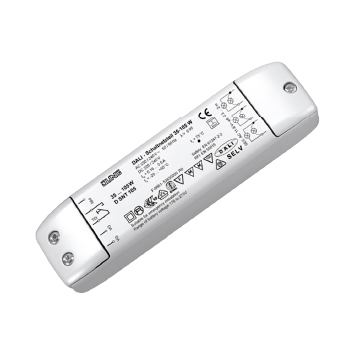
The DALI transformer for LV halogen lamps is used for power supply for 12-V halogen lamps and is installed in false ceilings or as surface mounting.
The KNX weather station universal serves to measure and evaluate weather data, such as wind speed, wind direction, precipitation, brightness, global radiation, twilight, temperature, relative humidity and atmospheric pressure. The weather station has an integrated GPS/GLONASS receiver for automated position determination.
In addition, the weather station universal can calculate further weather data such as absolute atmospheric humidity, feels-like temperature and comfort. Operation is with an additional power supply (reference number WSSV 10). The weather station is mounted in exteriors of buildings, preferably in the roof and facade areas.
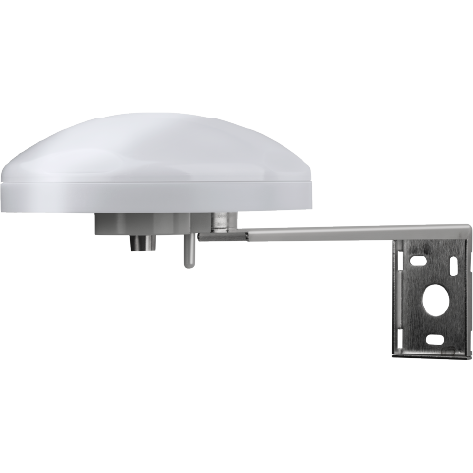
The KNX weather station home records the meteorological data of wind speed, precipitation, twilight, temperature and the brightness in 3 directions.
The main area of use is automatic, weather-dependent shading control. It is specially designed for home use. In order to increase the function security, the weather station self-monitors some important functions and registers any faults independently with message objects on the bus.
It is designed for external mounting on a pole or on the wall.
The bus coupling unit to the KNX is integrated.
The evaluation of the data themself, particularly the limit value processing is carried out in the weather station.
To protect against functional impairment from frost and condensation, it is protected by built-in heating down to –20 °C. The heating also provides fast drying after rain and melting of snow and ice for the sensor surface of the precipitation sensor.
With the exception of the heating and the precipitation sensor, the power supply for the unit is via the bus. For the heating, the weather station requires an external 24 V AC/DC power supply (reference number WSSV 10), without which no precipitation detection is possible.
Logic gates are available for cascading multiple weather stations and the linking of limit values and the monitoring function. Blocking elements allow individual functions on-site to be blocked.